Illustrated with AI-generated imagery and narration, made before the eclipse. It shows what was expected, not footage of the day. Sound on.
Total Solar Eclipse
For up to 2 minutes and 18 seconds, day became night along a path from the Arctic across Greenland and Iceland to northern Spain. Iceland's first totality since 1954. Mainland Spain's first since 1905.
—days
—hours
—min
—sec
Greatest eclipse 17:47:06 UTC · 40 mi (65 km) west of Iceland · magnitude 1.039 ·
Day Becomes Night
Fifty-two seconds on what happens when the moon's shadow crosses the Atlantic — and what it looks like from orbit, from Greenland's ice, from a Spanish plaza, and from inside the dark.
The Path
The shadow ran east to west — unusual for an eclipse — beginning at sunrise over northern Siberia, skimming past the North Pole, crossing Greenland and Iceland, then sweeping down the Atlantic to make landfall in northern Spain about an hour before local sunset. Everyone inside the dark band got totality; the rings around it show how deep a partial bite the rest of Europe, West Africa, and northeastern North America saw.
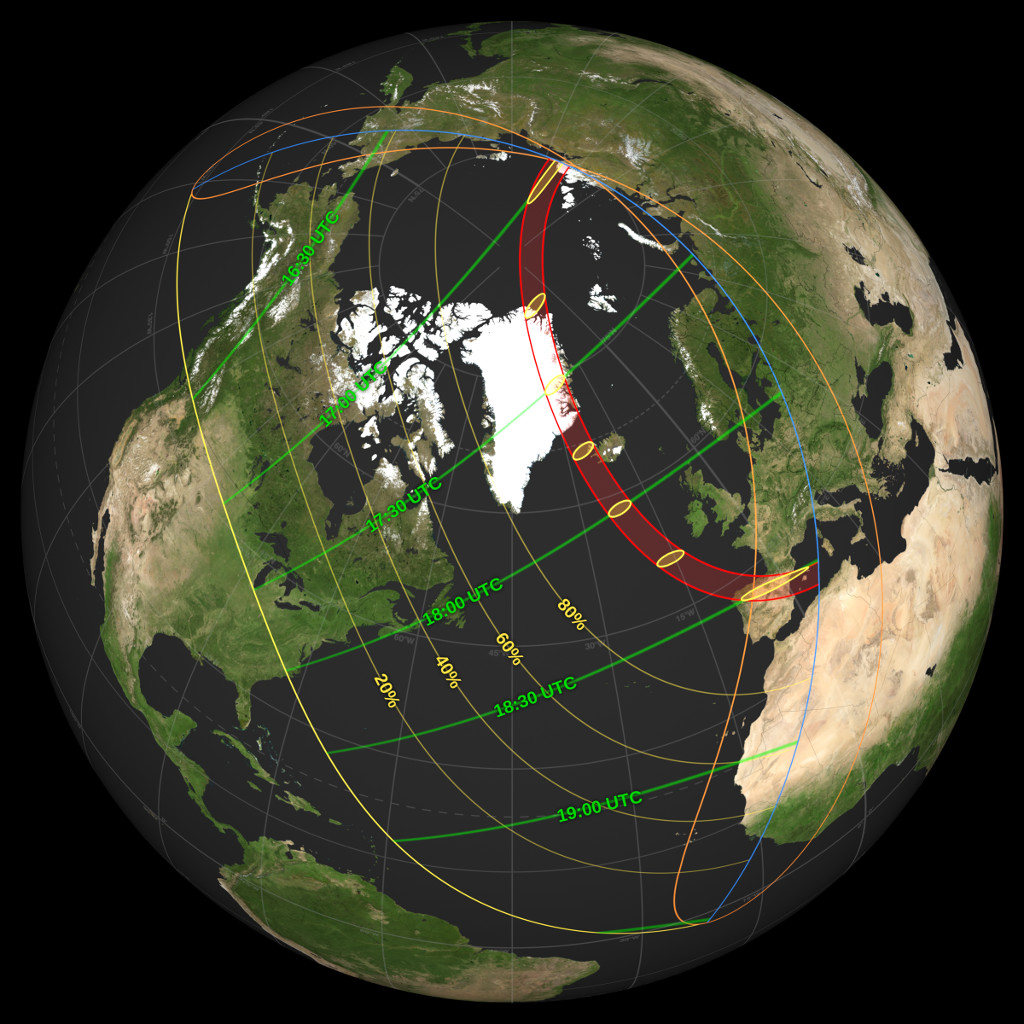
The official map, built from lunar terrain data — the path's edges wobble with the moon's real mountains and valleys. Map: NASA's Scientific Visualization Studio (Ernie Wright, USRA).
From Where You Stand
Eclipses are local events. The same moment was a black sun over Reykjavík, a deep bite out of the evening sun in Paris, and an ordinary Wednesday in California. This is what August 12 looked like from your spot — computed in your browser, nothing sent anywhere.
Your location
computing…Reading the geometry…
City times are UTC; your card above uses your device's clock. Every number on this page is computed live by Astronomy Engine — nothing is hand-entered.
The Day, As It Happened
Afternoon UTC
First contact over the Arctic. The moon took its first bite out of the sun at local sunrise in northern Siberia, and the partial eclipse spread across the top of the world.
~17:15 UTC
The full shadow touched down and began its run: over the pole's shoulder, then down across Greenland's ice sheet.
~17:48 UTC
Iceland went dark. Reykjavík sat inside the band for about a minute of totality; the shadow's center passed just offshore, where darkness lasted the full 2m 18s.
17:47:06 UTC
Greatest eclipse — magnitude 1.039, 40 mi (65 km) west of Iceland's coast. Up to 2m 18s of totality.
~18:27 UTC
Landfall in Spain. The shadow crossed the north coast with the sun hanging low in the west, swept southeast, and left past the Balearic Islands at dusk.
Two weeks later
On the night of August 27–28 the full moon slid through Earth's shadow, a partial lunar eclipse for the Americas, Europe, and Africa. The Moon room computes your local circumstances for the next one.
The Cloud Question
Going in, decades of August satellite records put the smart money on Spain's Ebro Valley, with Iceland a coin flip with a spectacular upside. These were the odds of a clear sky at eclipse hour.
The August odds — decades of satellite history
~75%
Ebro Valley, Spain
~65%
Spanish Meseta
~35%
Reykjavík area
~25%
East Greenland coast
Climatology: Jay Anderson, eclipsophile.com — the standard reference for eclipse weather. Percentages are approximate August means.
The forecast — cloud cover at maximum eclipse
Model forecast from Open-Meteo, fetched just now for each city's moment of maximum eclipse on August 12. Lower is better — and forecasts this far out are sketches, not promises. Check back; the picture sharpens daily.
Eclipse Day Coverage
On August 12 this page carried the sun as SDO saw it, the GOES-East view of the moon's shadow crossing the Atlantic, and these webcasts from inside the path. The links go to each broadcaster; check there for a replay.
The broadcasts
live on August 12- timeanddate from near León, Spain · 17:30 UTC
- ESA Web TV Javalambre observatory, Teruel
- Exploratorium telescope view from Villalibado, Spain · 17:30 UTC
- NASASpaceflight YouTube coverage · 17:00 UTC
Totality ran roughly 17:45–18:35 UTC along the path, Iceland first and Spain about forty minutes later.
The sun right now. SDO's 171 Å view, refreshed through the eclipse.
The shadow from space. GOES-East full disk — watch for the dark
smudge sliding across the North Atlantic. That's the umbra.
Live from the path
The four verified streams are listed above — pick one (or four). timeanddate's broadcast is the anchor coverage.
Webcasts. For everyone outside the path — which is most of us.
This page is now the permanent record of the August 12 eclipse. The next total solar eclipse is August 2, 2027, when the moon's shadow crosses southern Spain, North Africa, and Egypt.
Why This One Mattered
Totality is the only time human eyes can see the corona — the sun's outer atmosphere, a million-degree halo shaped by the same magnetic field lines the Space Weather room tracks every day. This eclipse came near solar maximum, when the corona is full and spiky rather than the trim streamers of a quiet sun. And it was a rare visit: the moon's shadow hadn't touched Iceland in 72 years, and mainland Spain had waited 121. The next chance to stand inside the shadow is August 2, 2027.